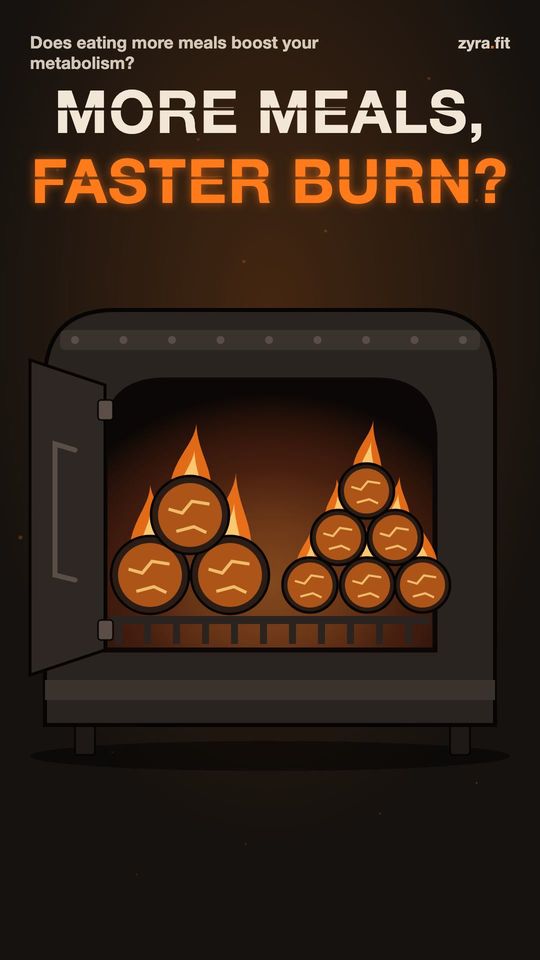
No, not in any meaningful way. When people ate the same food as two meals or three, their total energy use over 24 hours did not differ, and neither did the energy spent digesting it1. The idea that frequent small meals keep your metabolism running faster has not held up in chamber studies.
What can change with meal pattern is appetite and fuel use, not the calories you burn. This article covers what was measured, what it found, and where meal frequency may still matter.
Where the idea comes from
The theory is common in nutrition advice, and it runs like this. Digesting food costs energy, called the thermic effect of food: roughly a tenth of what you eat (see the thermic effect of food). Each meal triggers a rise in energy use. So more meals should mean more rises and a higher total.
The flaw is that the size of each rise scales with the size of the meal. Six small meals trigger six small rises; two big meals trigger two big ones. If total food is the same, the total cost should be about the same. That is the logic; the studies below test it.
What was studied
The best tool for this question is a respiration chamber: a sealed room (14 cubic metres in the 2008 study1) that measures the oxygen you use and the carbon dioxide you breathe out, minute by minute, for a whole day or more.
| Study | Who | Meal patterns compared | Setting |
|---|---|---|---|
| Verboeket-van de Venne 19933 | 10 men, BMI 20.7 to 30.4 | 2 vs 7 meals, same food | 1 week each, 36 h in a chamber, plus doubly labelled water |
| Taylor & Garrow 20014 | women with a BMI over 25 (10 in the main comparison) | 2 vs 6 meals, same food | chamber calorimeter |
| Smeets & Westerterp-Plantenga 20081 | 14 normal-weight women, average age 24 | 2 vs 3 meals, same food (9.2 MJ a day) | two 36 h sessions in a chamber, crossover |
A crossover means each person did both patterns, in random order, so each is compared with herself. MJ is megajoules: 1 MJ is about 239 kcal.
What the studies found
Two versus three meals. In the 2008 chamber study, total energy use was 8.2 MJ a day on two meals and 8.5 on three, not significantly different1. The energy spent digesting food (diet-induced thermogenesis) was 9.43% of intake on two meals and 9.90% on three, also not significant. Sleeping metabolic rate was 5.93 against 5.98 MJ a day. The authors state it plainly: eating three meals compared with two "had no effects on 24 h energy expenditure, diet-induced thermogenesis, activity-induced energy expenditure and sleeping metabolic rate".
Same food, two meals vs three: energy use in a respiration chamber · MJ/day
Two meals Three meals
Two versus seven meals. In the 1993 study, ten men ate at energy balance for a week on each pattern3. Meal frequency had no significant effect on 24-hour energy use in the chamber or on free-living energy use measured with doubly labelled water. The digestion cost was significantly higher with two meals at first, but that difference disappeared once the authors corrected for the time interval measured.
Two versus six meals. In women with a BMI over 25, in a chamber, energy use was 10.00 MJ on six meals and 9.96 MJ on two (p = 0.88)4. With two meals, more of the energy use shifted into the night, probably because the digestion of a later, larger meal continued overnight, the authors suggest.
The review view. A 1997 review concluded that studies of total 24-hour energy use "find no difference between nibbling and gorging", and that any effect of meal pattern on body weight is likely to act through food intake, not energy use5.
In plain terms: with the same food, the number of meals did not change how many calories the body used.
What about body composition?
A 2015 meta-analysis pooled 15 experimental studies on meal frequency and body composition2. At first, more frequent meals were linked with slightly more fat loss and fat-free mass gain. But its sensitivity analysis, a check of whether the result survives when studies are dropped, showed "the positive findings were the product of a single study". The authors concluded the findings "need to be interpreted with circumspection".
We read that meta-analysis as an abstract only, so we cannot say which study carried the result or how large the effect was.
In plain terms: once one study was set aside, the case for more meals disappeared.
Where meal pattern may still matter
Meal pattern did change some things that are not energy use.
- Fuel use. In the 2008 study, three meals burned more fat over 24 hours (76.3 g against 50.2 g) and less carbohydrate than two meals, at the same total energy1. Burning a different fuel mix is not the same as burning more energy.
- Fullness. Satiety scores over the day were higher with three meals than two in the same study1.
- Appetite hormones. In a 2024 crossover trial of 50 healthy adults, 3 against 6 eating occasions a day for 21 days each, with identical foods and energy, fasting appetite hormones did not differ significantly6.
So the practical question is less "which pattern burns more" and more "which pattern helps you eat the amount you intend". That depends on the person. For how the day's total is set, see how many calories should I eat; for why logged calories and macros can disagree, why macros don't add up to calories. A related question, whether an eating window changes results, is covered in our article on building muscle while intermittent fasting.
The studies at a glance
| Study | Who was studied | Key result | Year |
|---|---|---|---|
| Verboeket-van de Venne et al., *Br J Nutr*3 | 10 men, 2 vs 7 meals | No difference in 24-hour or free-living energy use | 1993 |
| Bellisle et al., *Br J Nutr*5 | Review | Chamber and doubly labelled water studies find no difference between nibbling and gorging | 1997 |
| Taylor & Garrow, *Int J Obes*4 | Women with a BMI over 25, 2 vs 6 meals | 24-hour energy use 9.96 vs 10.00 MJ (p = 0.88) | 2001 |
| Smeets & Westerterp-Plantenga, *Br J Nutr*1 | 14 normal-weight women, 2 vs 3 meals | 24-hour energy use 8.2 vs 8.5 MJ; digestion cost 9.4% vs 9.9%; both not significant | 2008 |
| Schoenfeld, Aragon, Krieger, *Nutr Rev*2 | 15 studies | Small edge for more meals came from a single study | 2015 |
| Zhang et al., *J Nutr*6 | 50 healthy adults, 3 vs 6 eating occasions | No significant difference in fasting appetite hormones | 2024 |
Limits worth knowing
- Small and short. The chamber studies had 10 to 14 people per comparison and lasted 36 hours to a week of each pattern.
- Narrow groups. Young normal-weight women in 2008, men in 1993, women with a BMI over 25 in 2001. Results may differ in other groups.
- Energy use, not long-term outcomes. These studies measured calories burned, not body weight over months.
- Abstract only for the 1993, 1997, 2001, 2015 and 2024 papers. We read the 2008 study in full.
- Different comparisons. Two versus three meals is not the same as two versus seven, although neither found a difference in 24-hour energy use.
Latest research
The newest trial we opened is from 2024: 50 healthy adults ate the same foods as 3 or 6 eating occasions a day, 21 days each6. Fasting ghrelin, leptin and adiponectin, hormones linked to appetite, did not differ significantly between patterns. It did not measure energy use. We found no newer chamber study that overturns the finding that meal count leaves 24-hour energy use unchanged. When one appears, this page will be updated and its date will change.
The short version
- With the same food, 2, 3, 6 or 7 meals a day gave no significant difference in 24-hour energy use in chamber studies.
- The cost of digestion follows how much you eat, not how often.
- A meta-analysis's small edge for more meals rested on a single study.
- Meal pattern can change fuel use and fullness, so the useful pattern is the one that helps you eat what you intend.
Educational overview only — not medical advice.