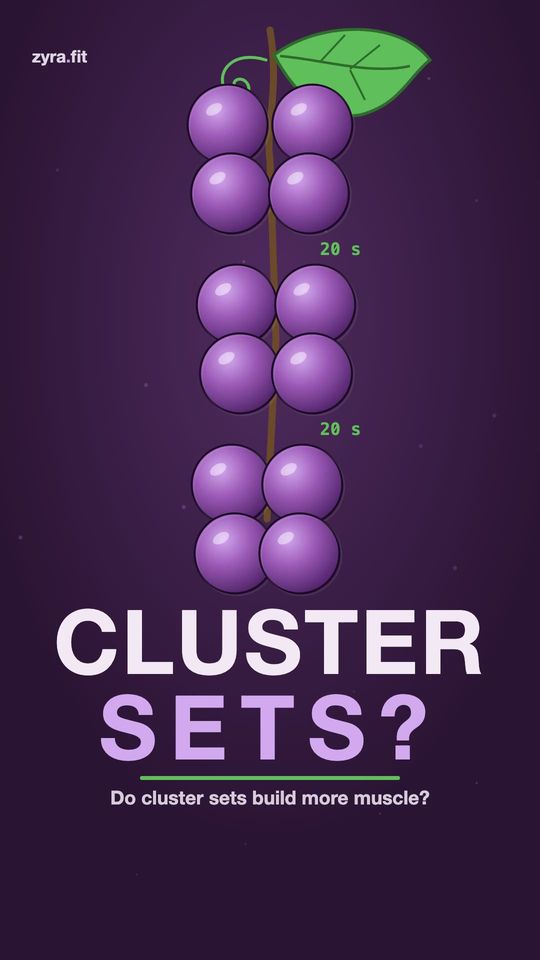
No, not on current evidence: a meta-analysis of 29 studies found cluster sets and traditional sets built the same amount of muscle1. A 2025 trial that matched sets, reps and effort found the same thing in trained lifters4. What clusters change is how the set feels and how fast the bar moves, not how much you grow.
The details explain why the idea is appealing, why it has not paid off for muscle, and where it does make a difference.
What a cluster set is
A traditional set is all the reps in a row, without a break: 12 reps, then rest. A cluster set takes the same reps and splits them into mini-blocks with a short rest inside the set: for example, 4 reps, 20 seconds, 4 reps, 20 seconds, 4 reps4. A close cousin, rest redistribution, spreads the same total rest into more, shorter breaks2.
The idea is that the short breaks let you use a heavier load for the same reps, or keep every rep faster and cleaner. More load, the reasoning goes, might mean more growth. The 2025 trial authors expected exactly that: they hypothesised the cluster leg would lift more total load and grow more4.
For how clusters fit next to drop sets, supersets and the rest, see set types explained.
In plain terms: same reps, broken up with short pauses.
What the studies found
The pooled evidence. Davies and colleagues pooled 29 studies of at least 3 weeks that compared cluster and traditional set configurations1. They found no difference for hypertrophy (muscle growth: effect size −0.05, 95% confidence interval −0.32 to 0.23, p = 0.73)1. There was also no difference for strength, power, velocity or endurance, and none when they split the studies by training volume, cluster model, training status, body part or exercise1.
An effect size here is the gap between the two approaches on a common scale, where zero means no difference. A confidence interval is the range the true value most likely sits in; this one straddles zero.
Cluster vs traditional sets: pooled differences by outcome · effect size
A second meta-analysis, of 17 studies, reached the same conclusion for strength (effect size −0.06) and hypertrophy (−0.03): changing to a cluster or rest-redistribution structure had "a negligible impact"2.
The effort-matched trial. Vargas-Molina and colleagues wanted a stricter test. They took 10 people with at least 2 years of training (7 men, 3 women, average age 21) and trained each leg a different way for 8 weeks, with the leg for each protocol assigned at random4. Both legs did 5 sets of 12 on the leg press and leg extension, twice a week. The traditional leg did 12 in a row; the cluster leg did 3 clusters of 4 with 20 seconds between them4. Loads were set so every set, and every cluster, ended 0 to 1 reps short of failure, what trainers call RIR 0–1 (reps in reserve: how many more reps you could have done)4.
Both legs grew. Front-thigh muscle thickness, measured by ultrasound, rose 0.24 cm with clusters (95% CI 0.14 to 0.34) and 0.17 cm with traditional sets (0.07 to 0.27)4. Thigh lean tissue, measured by a DXA body scan, rose about 172 g and 201 g as group averages4. Neither gap was significant (p = 0.297 and 0.272)4. And against the authors' own hypothesis, the cluster leg did not lift more total load in any session4.
Front-thigh muscle thickness change after 8 weeks · cm
The authors concluded the two were "equally effective in promoting muscle development"4.
In plain terms: when both approaches were pushed equally hard, the muscle could not tell them apart.
Why some trials found traditional sets ahead
Not every trial is a tie, and the exceptions are instructive.
In a 2022 trial, 21 recreationally trained men and women did 4 sets of 5 at 85% of their one-rep max on the bench press, either traditionally or with 30-second rests between reps3. The traditional group slowed down more within each set, and it gained more thickness in the upper region of the chest (effect size 0.34 favouring traditional)3. Other outcomes did not differ significantly3.
In a 2025 trial of 42 trained men doing full squats, traditional sets gave more growth than clusters (30 seconds of rest every 2 reps) in the lower region of the outer quad5.
The common thread is likely effort. Those trials matched the groups by load, sets and reps rather than by effort, so the cluster rests probably left each rep further from failure. The 2022 authors point to the bigger slowdown within traditional sets as the likely reason for the regional edge3. When the 2025 effort-matched trial pushed every cluster to near failure, the gap disappeared4. This is our reading across studies, not a result any single one tested.
For more on how close to failure matters, see RIR vs RPE.
In plain terms: breaks inside a set only cost growth if they make the set easier.
What cluster sets do change
Clusters are not useless; they just do a different job. In the 17-study meta-analysis, cluster and rest-redistribution structures produced greater velocity and power at submaximal loads (effect size 0.18) and shifted people towards a more speed-dominant profile2. Traditional sets were better for muscular endurance (effect size 0.38 favouring traditional)2.
The 29-study authors add that clusters "may" reach the same adaptations "with less fatigue development" during training1. That is a hedged statement, and fatigue during a session is not the same as recovery between sessions.
So the trials describe clusters as a tool for heavier or faster sets with less slowdown, used by people training for speed and power, and as one option among several set structures for those after muscle. For rest between full sets, see how long to rest between sets.
The studies at a glance
| Study | Who was studied | Key result | Year |
|---|---|---|---|
| Davies et al., *Sports Med*1 | Meta-analysis, 29 studies, at least 3 weeks | No difference for hypertrophy (−0.05, p = 0.73), strength, power, velocity or endurance | 2021 |
| Jukic et al., *Sports Med*2 | Meta-analysis, 17 studies | Negligible impact on strength (−0.06) and hypertrophy (−0.03); more velocity and power with clusters (0.18) | 2021 |
| Davies et al., *J Strength Cond Res*3 | 21 recreationally trained men and women, 8 weeks, bench press | Traditional sets gave more upper-chest thickness (0.34); other outcomes no significant difference | 2022 |
| Vargas-Molina et al., *Eur J Appl Physiol*4 | 10 trained adults, 8 weeks, one leg each way, effort matched | Thickness +0.24 vs +0.17 cm, lean tissue +172 vs +201 g; no significant difference | 2025 |
| Cornejo-Daza et al., *Med Sci Sports Exerc*5 | 42 trained men, 8 weeks, full squat | Traditional sets grew the lower outer quad more than clusters | 2025 |
Limits worth knowing
- A tiny trial. Ten people, 8 weeks, one spot on one thigh muscle; DXA lean tissue includes more than muscle4.
- Young, trained, homogeneous. The 2025 trial studied people around 21 years old4.
- Mixed designs in the pooled data. The 29 studies used different cluster models, loads and populations; subgroup splits found no differences, but small subgroups have little power1.
- Regional findings are small. The traditional-set advantages in 2022 and 2025 appeared in single regions of a muscle, not across the board.
- Declared interest. One author of the 2025 trial formerly advised a fitness-equipment maker; the others declared none4.
- Abstract only for both meta-analyses and the 2022 and 2025 squat and bench trials; the 2025 leg trial was read in full text.
Latest research
The newest trial we found is the 2025 full-squat study in 42 resistance-trained men, which crossed set structure with blood flow restriction (a cuff that partly limits blood flow to the working limb)5. Over 8 weeks at 55% to 65% of one-rep max, traditional sets grew the lower outer quad more than clusters, and the traditional-with-cuff group had the largest gains across the muscle5. Clusters without a cuff produced larger gains in one-rep max and speed at submaximal loads than traditional sets without one5.
The authors describe the adaptations as "highly specific" to each protocol5. With four small groups, read it as a map of trade-offs, not a ranking. It fits the wider picture: clusters lean towards speed, and traditional sets taken close to failure are hard to beat for growth.
The short version
- Across 29 studies, cluster sets and traditional sets built muscle equally.
- When every cluster was pushed as close to failure as a normal set, growth still matched.
- Where clusters made sets easier, traditional sets sometimes grew specific regions more.
- Clusters tend to help bar speed and power rather than size.
Educational overview only — not medical advice.