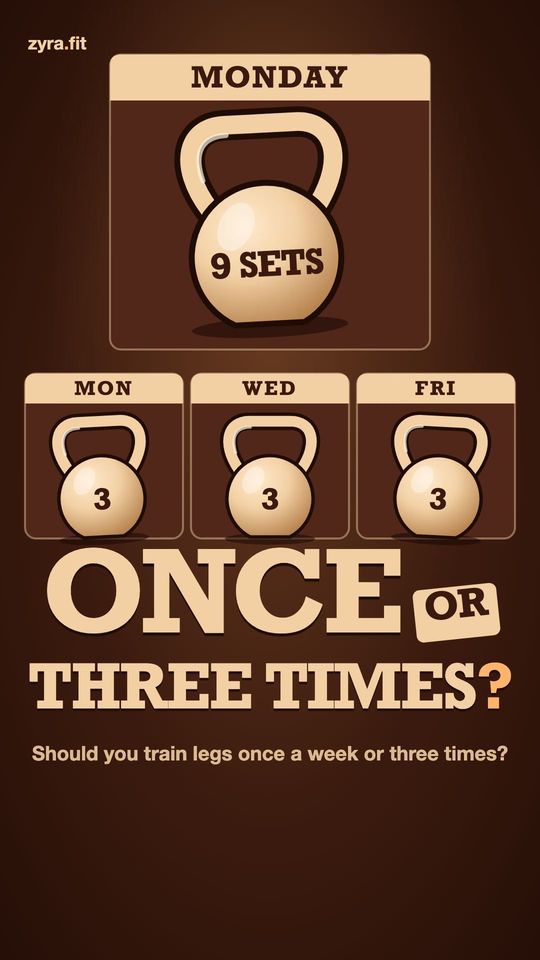
How many days a week you should lift is mostly a question of how many working sets you can fit into a week, because days multiply into sets and sets are what the muscles receive. This article takes the question as the arithmetic it is — using the rules the Zyra Workouts generator runs on — and adds what the frequency research found: with the same weekly sets, how many days you spread them over made little difference to muscle growth in the pooled studies3. It is not a personal recommendation. Someone who can train three days and does is better served than someone who plans six and manages two.
Days are a budget for sets
The generator builds a week from three inputs that multiply together:
weekly working sets = days × exercises per session × sets per exercise
Each factor is a rule, not a guess:
- Days run from 2 to 6. The generator does not build a 1-day or a 7-day week.
- Exercises per session come from the session length:
clamp(round(minutes / 12), 3, 8). - Sets per exercise come from the goal and experience: 3 as the base (4 for strength-goal compounds), one fewer for a beginner, one more on compounds for an advanced lifter, never below 2.
The number that budget is measured against is the app's set of weekly landmarks — the per-muscle lines on the dashboard's coverage bars. They are the app's defaults for tracking, not a law, and they sum to 120:
| Muscle | Landmark (sets/week) | Muscle | Landmark (sets/week) |
|---|---|---|---|
| Chest | 12 | Quads | 14 |
| Back | 14 | Hamstrings | 10 |
| Shoulders | 14 | Glutes | 10 |
| Biceps | 10 | Calves | 10 |
| Triceps | 10 | Core | 10 |
| Forearms | 6 | Total | 120 |
A set counts 1 toward the exercise's primary muscle and 0.5 toward each secondary, so a week of compounds credits more than its raw set count — a back squat set is 1 quads plus 0.5 each for glutes, hamstrings and core. Even so, the budget is what it is: more days or longer sessions are the only ways to raise it.
In plain terms: before asking which split, ask how many sets a week your schedule actually contains.
Two to six days — what each buys
Fix the session at 60 minutes (5 exercises) and the lifter at intermediate on a hypertrophy goal (3 sets an exercise), and the week is 15 working sets a day:
| Days | Week layout | Working sets a week | Share of the 120-set landmark total | Frequency per muscle (full body / upper-lower / push-pull-legs) |
|---|---|---|---|---|
| 2 | T·R·R·T·R·R·R | 30 | 25% | 2 / 1 / 1 (no legs day) |
| 3 | T·R·T·R·T·R·R | 45 | 38% | 3 / 2 upper, 1 lower / 1 |
| 4 | T·T·R·T·R·T·R | 60 | 50% | 4 / 2 / 2 push, 1 pull, 1 legs |
| 5 | T·T·T·R·T·T·R | 75 | 63% | 5 / 3 upper, 2 lower / 2 push, 2 pull, 1 legs |
| 6 | T·T·T·T·T·T·R | 90 | 75% | 6 / 3 / 2 |
Two things stand out. Even six 60-minute days at 3 sets do not reach the landmark total; the generated 6-day push/pull/legs gets to 106 only because its advanced setting adds a fourth set to compounds. And the "share" column is an average — actual credit is lumpy, because the roster rule and secondary crediting pile sets onto some muscles and leave others short. The weekly sets calculator shows the real per-muscle picture for any week.
Frequency is the other thing days buy. The full-body roster trains its six muscles every session; upper/lower needs 4 days to reach twice a week for everything; push/pull/legs needs 6. On the evidence side, the meta-analysis we cite pooled studies in which the same weekly volume was split across one, two or three sessions per muscle and found that twice a week produced greater hypertrophy than once; whether three beats two it could not determine from the studies available1. That is one pooled result about volume-equated training, not a rule for any individual, and it says nothing about what happens when more days also mean more sets.
In plain terms: each extra day adds 15 sets to this budget and, depending on the split, one more visit per muscle. Twice a week per muscle beat once in the 2016 analysis; the newer, larger analyses below found frequency matters little for growth when the weekly sets are the same.
Session length changes the answer
Days are not the only lever, and often not the easiest one. The exercises-per-session rule means session length trades directly against days:
| Minutes | Exercises per session | Sets a session (×3) | 3 days | 4 days | 5 days |
|---|---|---|---|---|---|
| 30 | 3 | 9 | 27 | 36 | 45 |
| 45 | 4 | 12 | 36 | 48 | 60 |
| 60 | 5 | 15 | 45 | 60 | 75 |
| 75 | 6 | 18 | 54 | 72 | 90 |
| 90 | 8 | 24 | 72 | 96 | 120 |
Three 90-minute days (72 sets) buy more than four 45-minute days (48). Four 60-minute days equal five 45-minute days (60 each). The 90-minute row is the only one that reaches the 120 total at all, and only at 5 days. What the table cannot show is which combination you will still be doing in cycle 5 — that is the variable that dominates all the others.
Rest time is part of why longer sessions buy more: a compound carries a 180-second default rest in the catalog, an isolation 60 seconds, so a 5-compound day spends more of its hour resting than a mixed day does.
What the frequency research found
The 2016 meta-analysis above pooled 10 studies1. The evidence has grown since, and the answer has become simpler: for muscle growth, the weekly sets matter far more than how many days they are spread over.
Growth. A 2019 meta-analysis of 25 studies found no significant difference in muscle growth between higher and lower frequencies when weekly volume was equated3. That held for direct measures of growth, for resistance-trained people, and for upper and lower body separately. In studies where more sessions also meant more sets, higher frequencies came out ahead, but the difference between 1 and 3 or more days a week was modest. The authors concluded that, for a given volume, people can choose a frequency "based on personal preference"3.
Strength. A 2018 meta-analysis of 22 studies found strength gains rose with frequency: effect sizes of 0.74, 0.82, 0.93 and 1.08 for training 1, 2, 3 and 4 or more times a week2. When weekly volume was equated, the effect of frequency was not significant (p = 0.421), so the authors attribute the rise mainly to the extra sets that extra days allow2.
Strength gain effect size by sessions per week · ES
The largest analysis so far. A 2026 set of meta-regressions pooled 67 studies with 2,058 participants4. Muscle growth and strength both rose with weekly sets, with diminishing returns. For frequency, the growth results were compatible with a negligible effect, while strength gains did increase with more sessions per week, again with diminishing returns4. Notably, it counted a set for a muscle that works only as a helper as half a set, the same half-credit rule the app uses for secondary muscles.
Spreading the same sets out. A 2026 trial gave 18 trained men the same lower-body sets (3 weekly sets each of back squat, leg press and leg extension, at 80% of 1RM to failure), either all in 1 session or spread over 35. After 6 weeks, the 3-session group had lifted more total volume load: 58% more on the back squat and 76% more on the leg press. Strength gains leaned toward the 3-session group without reaching significance, and quadriceps thickness grew similarly in both5.
How the training-frequency evidence built up
- 201610 studiesVolume-equated: twice a week per muscle beat once; three vs two unresolved
- 201822 studies, strengthMore sessions, bigger strength gains; no significant effect when volume was equated
- 201925 studies, growthNo significant difference by frequency when volume was equated
- 202667 studies, 2,058 peopleFrequency compatible with negligible effect on growth; strength rose with frequency, with diminishing returns
- 202618 trained menSame weekly sets in 3 sessions vs 1: more volume load, similar muscle thickness
In plain terms: more days a week mostly help by making room for more sets. With the same sets, spreading them out lets you lift a bit more per set and may help strength slightly, but in these studies it did not add measurable muscle.
The studies at a glance
| Study | Who was studied | Key result | Year |
|---|---|---|---|
| Schoenfeld et al., *Sports Med*1 | Meta-analysis, 10 studies | Volume-equated: twice a week per muscle beat once (effect size 0.49 vs 0.30); three vs two unresolved | 2016 |
| Grgic et al., *Sports Med*2 | Meta-analysis, 22 studies, mostly untrained | Strength rose with frequency; no significant effect when volume was equated | 2018 |
| Schoenfeld et al., *J Sports Sci*3 | Meta-analysis, 25 studies | No significant growth difference by frequency when volume was equated | 2019 |
| Pelland et al., *Sports Med*4 | Meta-regressions, 67 studies, 2,058 people | Growth: frequency compatible with negligible effect; strength rose with frequency, diminishing returns | 2026 |
| Calzavara & Barroso, *J Strength Cond Res*5 | 18 trained men, 6 weeks, same sets in 1 vs 3 sessions | More volume load with 3 sessions; similar muscle thickness | 2026 |
Limits worth knowing
- Mostly young, untrained people in the pooled studies; the 2018 authors call for more evidence in trained lifters2. In the 2026 meta-regressions, the average age was about 25 and 79% of participants were men4.
- Short trials. Most last weeks to a few months; the 2026 set-distribution trial ran 6 weeks with 18 men5.
- Abstracts only. We read the abstracts of all five papers; the set-distribution trial's full text is behind a paywall.
- Frequency here means per muscle in most studies, not total gym days; the two are the same only on a full-body layout.
Latest research
The newest study we opened is the 2026 set-distribution trial in 18 trained men5. Spreading the same 3 weekly sets per exercise over 3 sessions instead of 1 raised volume load by 58% on the back squat and 76% on the leg press. Strength gains leaned toward the 3-session group (p = 0.074 and 0.071, not significant), and quadriceps thickness grew similarly in both. The authors' reading: the extra volume load gave "only directional support" for strength and did not translate into more muscle over 6 weeks. The larger 2026 meta-regressions point the same way for growth4.
The short version
Days a week is a set budget: days × exercises × sets, where exercises come from minutes ÷ 12 and sets from goal and experience. At 60 minutes and 3 sets, 2 days is 30 working sets and 6 days is 90, against landmarks that total 120. A 2016 meta-analysis found twice a week per muscle better than once with volume held equal1; larger analyses since found frequency makes little difference to growth when weekly sets are equal, while strength rises somewhat with more sessions34. Pick the days and minutes you will actually keep, then check the week with the weekly sets calculator and choose the split that reaches twice a week at that days count. This is training arithmetic plus the frequency research. Educational overview only — not medical advice.