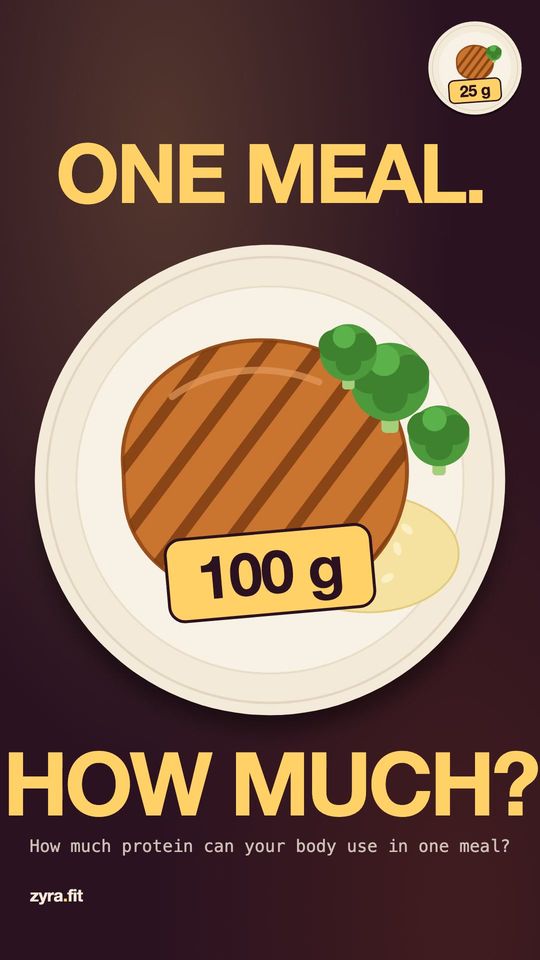
More than the popular 20 to 30 gram rule suggests, and no study has found a hard ceiling. In a 2023 trial, young men given 100 g of protein after a workout were still building it into muscle 12 hours later, and very little of the extra was burned for energy5.
The per-meal limit people quote comes from a real finding, just a narrow one. This article traces where the number came from and what the newer, longer measurements show.
Absorbing is not the same as using
Two different questions get mixed up here. Absorption means protein passing from the gut into the blood. For whole proteins that is "virtually unlimited": almost all of the amino acids (the building blocks protein is made of) eventually become available to the body's tissues4.
The real question is how much of a meal the muscle uses to build new protein. Scientists measure this as muscle protein synthesis, the rate at which muscle makes new protein. The claim behind the "per-meal limit" is that this rate tops out at about 20 to 25 g of high-quality protein and the rest is burned for energy4.
In plain terms: you absorb nearly all of it; the debate is about what happens next.
Where the 20 to 25 gram idea came from
The number is not made up. In a 2014 trial, 48 trained young men did a leg workout after a protein-rich breakfast, then took 0, 10, 20 or 40 g of a fast-digesting milk protein1. The workout trained one leg. Over the next 4 hours, muscle-building rates rose 49% above zero with 20 g and 56% with 40 g. The authors read 20 g as enough for the maximum, and the 40 g dose raised the markers of protein being burned for energy.
A 2015 pooled analysis put the plateau for young men at about 0.24 g per kg of body weight, and higher, about 0.40 g per kg, for men around 712. Per kg of body weight that age difference was borderline (p = 0.055); it was clear only per kg of lean mass.
The 2018 review points out the limits of that evidence. The 20 to 25 g finding is specific to fast-digesting protein taken on its own, without other nutrients4. And a one-leg workout puts far less muscle to work than a full session.
When the workout used the whole body, 40 g did better than 20 g. The review's authors suggest the larger amount of trained muscle created a larger demand4. In 30 trained men, muscle-building rates were 0.059% per hour after 40 g against 0.049% after 20 g, whatever the men's lean mass3.
How the per-meal protein question developed
- 2014One-leg workout, 4 hours20 g near the plateau; 40 g added little and raised burning
- 2015Pooled dose dataPlateau about 0.24 g/kg in young men, 0.40 g/kg in older men
- 2016Whole-body workout40 g gave higher muscle-building rates than 20 g
- 2018ReviewAbsorption is not the limit; about 0.4 g/kg per meal suggested
- 2023100 g over 12 hoursBigger and longer response than 25 g, negligible extra burning
The 100 gram study
The 2023 trial tested a far larger dose over a far longer window5.
| What | Detail |
|---|---|
| Who | 36 healthy, recreationally active men aged 18–40, 12 per group |
| Design | Randomised, double-blind, placebo-controlled |
| Workout | 60-minute whole-body session (leg press, leg extension, lat pulldown, chest press) |
| Protein | 0, 25 or 100 g of milk protein in water, right after training |
| Measured | Blood every 30 to 60 minutes and muscle samples at 0, 4, 8 and 12 hours |
The protein was labelled with tracers, amino acids carrying a slightly heavier atom. That let the team follow the meal's own protein from the gut into the blood and then into muscle, separately from the body's existing protein5.
What the 100 gram study found
Bigger and longer. Muscle-building rates over the 12 hours ranked 100 g above 25 g above none. Compared with 25 g, the 100 g dose gave rates about 20% higher in the first 4 hours and about 40% higher in hours 4 to 125.
Still digesting at hour 12. After 25 g, amino acids in the blood were raised for about 5 hours. After 100 g they stayed raised for the whole 12 hours. By hour 12, 16 g of the 25 g dose had reached the blood, against 53 g of the 100 g dose, and the 100 g curve had not levelled off5.
Share of the meal’s protein that had reached the blood · % of dose
25 g dose 100 g dose
More built into muscle. About 18% of the 25 g dose was built into muscle by hour 12. For the 100 g dose it was 13 g, 13% of the protein, and still rising in a straight line when measurement stopped5.
Where the meal’s protein had gone by hour 12 · g
Barely any extra burned. Burning of amino acids for energy rose with the dose, but the rise was "negligible" next to the rise in whole-body protein building. Protein breakdown hardly changed. Re-reading earlier dose studies the same way, the authors estimate that under 15% of extra protein is burned and over 85% goes to building tissue5.
In plain terms: a big meal of protein is not wasted. It is used more slowly, over many hours.
What it does and does not mean
It does not show 100 g meals build more muscle. This was a single meal on a single day, measuring where the protein went. It did not measure muscle growth over weeks5. The authors call their 100 g figures "minimal estimates", because the response had not ended at 12 hours.
It does not make spreading pointless. The 2018 review, written before this study, suggested about 0.4 g of protein per kg of body weight per meal across at least four meals, to reach at least 1.6 g per kg a day4. At the upper end of 2.2 g per kg a day, that works out to about 0.55 g per kg per meal. That is a convenient pattern, not a limit. The 2023 authors say their findings "support more flexibility" in how meals are arranged5. The sibling piece on spreading protein through the day looks at the trials of meal patterns directly.
Food speed matters, not just grams. A fast-digesting protein reaches the blood at about 10 g an hour; cooked egg at about 3 g an hour4. A mixed meal of whole food is digested more slowly than a protein drink on its own, which spreads the supply out by itself.
Age may matter. In the authors' reading, older men needed more protein per kg in a single meal to reach the same peak rate as younger men, though per kg of body weight the difference was borderline2.
For the daily total these per-meal numbers add up to, see how much protein per kg. The companion piece on the anabolic window covers why the hour after training matters less than people think.
What the studies found
| Study | Who was studied | Key result | Year |
|---|---|---|---|
| Witard et al., *Am J Clin Nutr*1 | 48 trained young men, one-leg workout, 4 hours | 20 g raised muscle building 49%, 40 g 56%; 40 g raised burning markers | 2014 |
| Moore et al., *J Gerontol A*2 | Pooled data, younger (about 22) and older (about 71) men | Plateau at about 0.24 g/kg (young) vs 0.40 g/kg (older); age difference borderline per kg body weight | 2015 |
| Macnaughton et al., *Physiol Rep*3 | 30 trained young men, whole-body workout | 40 g gave higher muscle building than 20 g | 2016 |
| Schoenfeld & Aragon, *JISSN*4 | Review of acute and longer-term studies | Absorption not the limit; about 0.4 g/kg per meal over 4+ meals suggested | 2018 |
| Trommelen et al., *Cell Rep Med*5 | 36 young men, whole-body workout, 12 hours | 100 g gave a bigger, longer response than 25 g; negligible extra burning | 2023 |
Limits worth knowing
- Young men only. The 2023 authors say they "do not know" whether the results apply to women, older people or other conditions5.
- One meal, one day. Short-term protein handling, not muscle growth over months.
- A drink, not a plate. The 100 g was milk protein in water, not a mixed meal.
- Small groups. 12 men per group in 2023; 30 in 2016; 48 across four doses in 2014.
- Abstract only. We read the 2014, 2015 and 2016 studies as abstracts and use only their stated numbers. Supplementary tables of the 2023 study were not read.
Latest research
The newest study we opened on this question is the 2023 100 g trial5. Its title states the result plainly: the response to protein after exercise "has no upper limit in magnitude and duration" within what the study measured. We found no newer trial that tests very large single meals against spread meals for muscle growth over weeks. That is the study still missing, and this page will be updated when one appears.
The short version
- Your body absorbs nearly all the protein in a meal; the question is how much the muscle uses.
- The 20 to 25 g figure came from short studies of one fast-digesting protein, some after a one-leg workout.
- After a whole-body workout, 100 g kept muscle building for at least 12 hours, with little extra burned.
- About 0.4 g per kg per meal across four meals is a practical pattern from the 2018 review, not a ceiling.
Educational overview only — not medical advice.