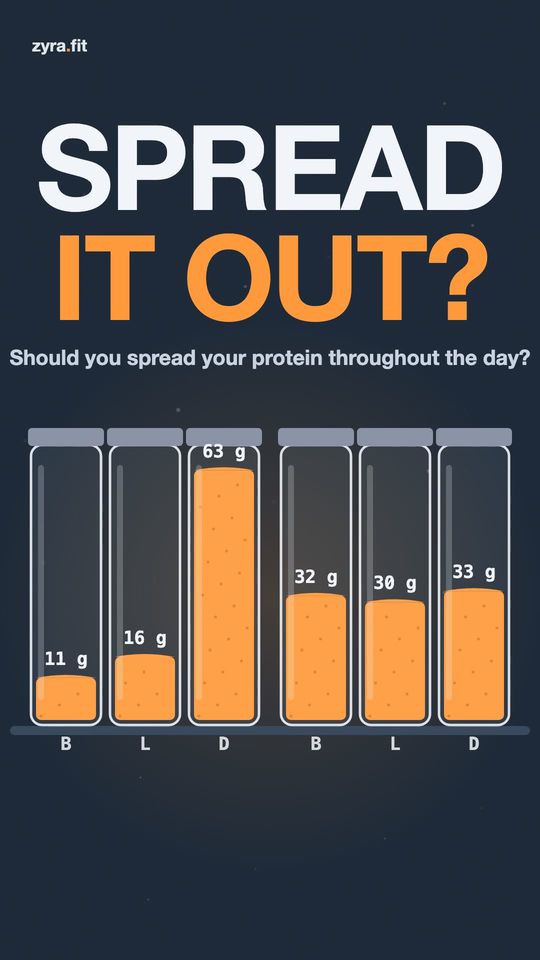
It may help a little, but the daily total matters far more, and the evidence on spreading is mixed. One well-known study found about a third more muscle building in 24 hours when protein was split evenly across meals1, but longer trials that matched daily protein mostly found no difference in lean mass26.
Most people eat little protein at breakfast and a lot at dinner. The question is whether moving some of that dinner protein earlier changes anything.
What "even" and "skewed" mean
Even means about the same protein at each main meal. Skewed means most of it at dinner. In the trials, both patterns gave the same daily total, so the only thing that changed was the timing.
Researchers measure the effect two ways:
- Muscle protein synthesis, the rate at which muscle builds new protein, over one to three days. It is sensitive but short.
- Lean mass, measured by body scans over weeks or months. It is closer to the outcome people care about, but slower and noisier.
Protein per meal in the 2014 study’s two diets · g
Skewed Even
The 24-hour study that started it
In 2014, eight healthy adults aged 25 to 55 ate two diets for seven days each, in random order (a crossover, where each person tries both)1. Both diets gave about 90 g of protein a day. The even diet planned about 30 g at each meal. The skewed diet planned about 10 g at breakfast, 15 g at lunch and 65 g at dinner.
Muscle protein synthesis over 24 hours was about 34% higher with the even diet: 0.075% an hour against 0.056%1. The paper calls this 25% higher; 25% is how much lower the skewed rate was. The pattern held after seven days on each diet.
24-hour muscle protein synthesis, even vs skewed meals · %/h
Two details matter. The measurement required a tracer infusion over 24 hours in a research unit, so people were mostly in bed. And the study measured the rate of building, not muscle size or strength.
In plain terms: in a short, controlled setting, even meals gave a higher building rate.
What longer and newer trials found
- Older adults, 2022. Twenty-four men and women aged 65 to 80 were randomised to even or skewed meals. After a week to settle in, muscle building was measured over three free-living days using heavy water, a drink with a heavier form of hydrogen that traces building over days. Rates were 2.16% a day with even meals and 2.23% with skewed: no difference. How much of the meals' own protein reached muscle did not differ either5.
- Training during a calorie deficit, 2017. Forty-one adults with overweight did resistance training three days a week on a diet about 750 kcal a day below their needs for 16 weeks. They ate 90 g of protein a day, either 30/30/30 g or 10/20/60 g. Lean mass, fat mass and thigh muscle area changed the same way in both groups2.
- Young men training, 2020. Twenty-six men aged about 21 trained three times a week for 12 weeks on the same daily protein (1.3 g per kg). One group had more at breakfast, the other more at dinner. Both gained lean mass; the bigger-breakfast group gained 2.5 kg against 1.8 kg on average, a difference that did not reach statistical significance (P = 0.06) but was a large effect size (d = 0.80); the authors concluded the bigger breakfast was "more effective"3.
- Young adults training, 2025. Forty active young adults ate 1.1 to 1.2 g of protein per kg a day for 9 days of training, either balanced across five meals or loaded 10/30/60% across three. Daily muscle building did not differ between patterns, on an omnivorous or a vegan diet7.
- Women during a calorie deficit, 2024. Forty-three women aged 20 to 44 followed even or skewed protein for 16 weeks, starting with a 20% energy restriction. Pattern made no difference to changes in body composition6.
The two deficit trials used moderate, planned deficits. For how a deficit is sized, including the 35% cap and the calorie floors, see how big a calorie deficit should be.
Even vs skewed protein: what each trial found
- 20148 adults, 24 hoursMuscle building about a third higher with even meals
- 201741 adults, 16 weeksNo difference in lean mass during training and a deficit
- 202026 young men, 12 weeksTrend toward more lean mass with a bigger breakfast (P = 0.06)
- 202224 adults aged 65–80, 3 daysNo difference in muscle building
- 202443 women, 16 weeksNo difference in body composition changes
- 202540 young adults, 9 daysNo difference in daily muscle building
In plain terms: when the daily total was the same and adequate, how it was split rarely changed lean mass over weeks.
Why the results disagree
The 2022 authors list their own candidates5:
- Age. The 2014 study was in adults 25 to 55; theirs in adults 65 to 80.
- Activity. Near bed rest during a 24-hour infusion, the effect of normal daily movement on muscle building is small. Free-living days include it.
- Design and window. A crossover over 24 hours versus separate groups over three days.
A 2020 review of both observational and randomised studies concluded that the evidence is "limited and inconsistent" and that the effect of distribution "cannot be sufficiently disentangled" from the effect of total protein4.
What this means in practice
The trials describe patterns, not rules. Two points come through consistently.
The daily total comes first. Every trial held the total fixed. The 2020 review notes that for adults eating little protein (under 0.8 g per kg a day), a more even spread may simply be a practical way to eat more in total4.
At least one protein-rich meal. For adults already at 0.8 to 1.3 g per kg a day, the same review found the evidence better supports having at least one meal with enough protein to reach the per-meal plateau, whatever the spread4. How large that meal needs to be is covered in how much protein your body can use in one meal.
Spreading is still a reasonable way to reach a higher total without one very large meal. It is a convenience, not a requirement. See how much protein per kg for where the daily targets come from.
What the studies found
| Study | Who was studied | Key result | Year |
|---|---|---|---|
| Mamerow et al., *J Nutr*1 | 8 adults aged 25 to 55, crossover, 24-hour measure | Muscle building about 34% higher with even meals (0.075 vs 0.056% an hour) | 2014 |
| Hudson et al., *Am J Clin Nutr*2 | 41 adults with overweight, 16 weeks of training in a deficit | No difference in lean mass, fat mass or thigh muscle area | 2017 |
| Yasuda et al., *J Nutr*3 | 26 young men, 12 weeks of training | Bigger breakfast: 2.5 vs 1.8 kg lean mass gain on average (P = 0.06) | 2020 |
| Justesen et al., *Nutrients*5 | 24 adults aged 65 to 80, 3 free-living days | Muscle building 2.16 vs 2.23% a day: no difference | 2022 |
| De Leon et al., *J Nutr*6 | 43 women aged 20 to 44, 16 weeks, deficit | No difference in body composition changes | 2024 |
| Askow et al., *MSSE*7 | 40 active young adults, 9 days of training | Balanced vs loaded-late meals: same daily muscle building | 2025 |
Limits worth knowing
- Small samples. Eight people in the 2014 study, 24 to 43 in the others.
- Different outcomes. The 24-hour and 3-day studies measured building rates; the longer trials measured lean mass, which changes slowly.
- Populations vary. Middle-aged adults, older adults, young men, and adults with overweight in a deficit. No trial here was in experienced lifters eating a high-protein diet.
- Moderate totals. Daily protein sat around 1.0 to 1.3 g per kg in the trials that reported it. The 2022 authors warn against extending their result to much lower intakes or highly active people5.
- Abstract only. We read the 2017, 2020, 2024 and 2025 trials and the 2020 review as abstracts and use only their stated numbers.
Latest research
The newest trial we opened is from 20257. In 40 active young men and women training during 9 days of controlled feeding, daily muscle building rates were the same whether protein was balanced over five meals or loaded toward the last meal, on both omnivorous and vegan diets. Its protein level, 1.1 to 1.2 g per kg a day, is moderate, and 9 days is short, so it measures building rates rather than muscle gained.
The newest longer trial is from 20246. In 43 women under 45, even and skewed patterns gave the same changes in body composition over 16 weeks. Both point the same way as the 2017 and 2022 results: with the total fixed, the split did not show up.
The short version
- One 24-hour study found about a third more muscle building with even meals.
- Longer trials with the same daily protein mostly found no difference in lean mass.
- The daily total is the part every study agrees on.
- Spreading protein is a practical way to reach a total, not a rule.
Educational overview only — not medical advice.