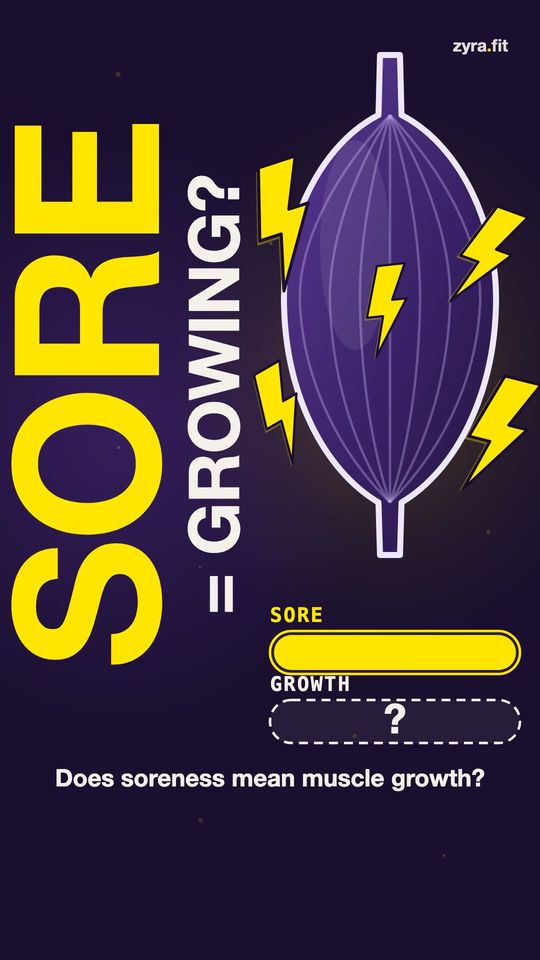
No. In the research, soreness tracked how new the training was, not how much muscle grew. In a 10-week study that took biopsies and scans, the men were sorest in the first week, yet no marker of muscle damage, soreness included, tracked how much muscle each of them gained2. By the third week the soreness was nearly gone and growth went on.
What was studied
Delayed onset muscle soreness (DOMS) is the ache that shows up a day or two after unfamiliar training. Muscle damage is the researchers' term for tiny disruption inside muscle fibres, seen under a microscope, along with a short dip in strength and a rise in a muscle enzyme in the blood. Muscle protein synthesis is the muscle's building rate: how fast it makes new protein.
The main study, by Damas and colleagues, followed 10 healthy young men (mean age 27) who had not trained their legs for at least 6 months2. They did leg press and leg extension twice a week for 10 weeks, 19 workouts in all, every set to fatigue2. We read it in full.
The team measured the men at three points: the first week, the third week and the tenth week. Each time they took thigh-muscle biopsies before and 24 and 48 hours after the workout, measured strength, and asked the men to rate soreness on a 100 mm scale, from 0 ("not sore at all") to 100 ("very, very sore")2.
| What | Detail |
|---|---|
| People | 10 untrained young men |
| Training | leg press + leg extension, 2 days a week, 10 weeks |
| Checks | week 1, week 3, week 10 |
| Measures | soreness, strength, blood enzyme, biopsies, ultrasound |
| Growth measure | change in thigh-muscle cross-section over 10 weeks |
In plain terms: the same men, measured in their sorest week and after they had adapted, with growth measured directly.
What the studies found
The first week was the sorest by far. Two days after the first-week workout, soreness averaged 61 of 100. In the third and tenth weeks it was 82. Strength two days after the first workout was down to 78% of that day's starting value, against about 98% in weeks 3 and 102.
Soreness after the workout, first, third and tenth week · mm (0–100)
24 h after 48 h after
The building rate was highest in that sore first week, but it did not predict growth. The men's building rate after the first-week workout was higher than in weeks 3 and 102. Yet it did not line up with who grew most over the 10 weeks: the correlation was r = −0.22, not significant2. A correlation (r) shows how closely two measures move together, from 0 (no link) to 1 (in step).
Once soreness faded, the building rate tracked growth closely. In week 3 the correlation was 0.86, and in week 10, 0.952.
Did the building rate after a workout track 10-week growth? · r
Soreness itself never tracked growth. In the authors' words: "No significant correlations were found between any hypertrophic marker … and indirect markers of muscle damage, i.e. MVC, SOR or CK at any time point"2. SOR is soreness; MVC is maximal strength; CK is the blood enzyme.
The authors' reading: when training is new, the muscle's building response goes "to support muscle repair rather than promote increases in muscle fibre" size2.
In plain terms: the sorest week was the week the building work went to repair; growth came once the soreness had faded.
Growth without the soreness
If soreness were needed, avoiding it should cost growth. A 2011 study tested exactly that1. One group eased in over three weeks, which avoided detectable damage. The other started with a damaging bout. Both then did the same eight weeks of hard eccentric (lowering-focused) cycling, with total work matched1.
The damaging-start group had more than five times higher levels of the muscle enzyme in the blood and reported more soreness. Yet muscle size gains were equal, and strength rose 25% and 26%1.
Strength gain after 8 weeks, with and without early damage · %
A 2018 review by the Damas group pulled this together: protocols that do not cause much damage still produced similar growth and strength to those that do, and the authors concluded that muscle damage "is not the process that mediates or potentiates" growth4.
What it does and does not mean
It does not mean soreness is bad. The studies did not test whether soreness harms growth. They found it did not predict it.
It does not mean the first weeks are wasted. The men were still training and adapting. A companion paper on the same 10 men found that early increases in muscle size on the scan were partly swelling (oedema), probably due to damage, rather than all new muscle; the authors suggest swelling may account for a large share of the early gain3. Muscle cross-section rose about 2.7% by week 3 and about 10.4% by week 103.
It does not mean less soreness is a sign of less progress. In these men, soreness dropped to near zero by week 3 while the building rate lined up with growth from then on2.
What soreness did track. In the main study it was high only while the training was new, and it faded as the men adapted2. How to judge progress without it is covered in how to track strength progress and what progressive overload is.
The studies at a glance
| Study | Who was studied | Key result | Year |
|---|---|---|---|
| Flann et al., *J Exp Biol*1 | Two groups, 8 weeks of eccentric cycling; one avoided early damage | Same muscle size gain; strength +25% vs +26% | 2011 |
| Damas et al., *J Physiol*2 | 10 untrained young men; legs; 10 weeks; biopsies | Soreness 61 → 8 by week 3; no damage marker, soreness included, correlated with growth | 2016 |
| Damas et al., *Eur J Appl Physiol*3 | The same 10 men; ultrasound | Early size gain partly swelling; about 10.4% by week 10 | 2016 |
| Damas, Libardi, Ugrinowitsch, *Eur J Appl Physiol*4 | Review | Low-damage training grew muscle similarly; damage not the driver | 2018 |
| Morin et al., *Med Sci Sports Exerc*5 | Hamstring exercises; modelling plus imaging | For knee-bending exercises, the most-damaged and most-grown hamstring muscle followed muscle length and force; not for the stiff-leg deadlift | 2026 |
Limits worth knowing
- Ten men. The main study was small, all men, untrained, one muscle group, ten weeks2.
- Mild to moderate damage. It was a normal lifting programme, not an extreme lowering protocol2.
- Correlation, not a test of soreness. Nobody was assigned to be sore or not sore in the main study; the 2011 study did that, and we read only its abstract.
- Abstracts only for the companion paper, the 2011 study, the 2018 review and the 2026 study.
- Not tested in trained lifters. Whether the same holds for experienced lifters was not measured here.
Latest research
The newest study we opened is from 2026, on the hamstrings5. It compared exercises and found that, for the knee-bending exercises, the hamstring muscle most affected after a session was also the one that grew most over training with that exercise, and that both followed where the muscle worked at long lengths under high force5. For the stiff-leg deadlift, the muscles did not differ clearly in how affected they were, and force did not explain which grew most5. It measured stiffness changes, not soreness. Our reading: damage and growth can share a cause (how an exercise loads a muscle) without damage being what drives growth. That fits the older findings rather than overturning them.
The short version
- In a 10-week biopsy study, soreness peaked in the first week and was nearly gone by week 3, while growth continued.
- No damage marker, soreness included, correlated with how much muscle each man grew.
- A study that avoided early damage found the same size and strength gains as one that caused it.
- In these studies, soreness tracked how new the training was, not how well it was working.
Educational overview only — not medical advice.